Today, undergoing digital transformation is no longer a competitive boost. It’s table stakes for banks and credit unions that want to attract and retain long-term relationships. An impactful place to start modernization is lending.
On the whole, financial institutions are meeting the moment. Roughly three-quarters of financial institutions plan to increase their technology spend over the next two years. Credit unions are the most committed, with 47% expecting to up their tech investments by between 6% and 10%.
When it comes to actually upgrading your lending tech, the process can seem intimidating. But, in reality, there are just two primary systems to consider on the journey to digitization.
- On the front-end, there’s the point-of-sale (POS) system that provides an application interface for borrowers.
- On the backend, the loan origination system (LOS) that bankers and loan officers use to manage the complete loan lifecycle from application through funding.
For providers looking for lending solutions, the choice can feel binary. Either they invest in a POS layer that sits on top of an existing LOS to quickly improve the borrower experience and increase conversion rates, or they commit to a full LOS upgrade that manages the entire journey but requires significant investment from a cost and change management perspective.
But, the truth is, there are pros and cons to both. The right solution will offer built-in agility, freeing your team to innovate and evolve.
The strategic use cases for POS vs. LOS
While digital transformation and tech investment is an ongoing process, many financial institutions still operate on legacy loan origination systems. In fact, McKinsey estimates that up to 75% of US credit unions are still operating on legacy LOS platforms that don’t offer true automation. These solutions lack modern POS interfaces, as they were often built when online loan applications felt like a far-off future possibility. The tech was suitable enough when there was an expectation borrowers would walk into a branch or call a loan officer to kickstart the origination process. In today’s digital landscape, borrowers are often able to self-serve until they click “submit” on their application. Modern platforms can offer self-driven capabilities past application submission in an easily accessible portal for a unified, end-to-end experience.
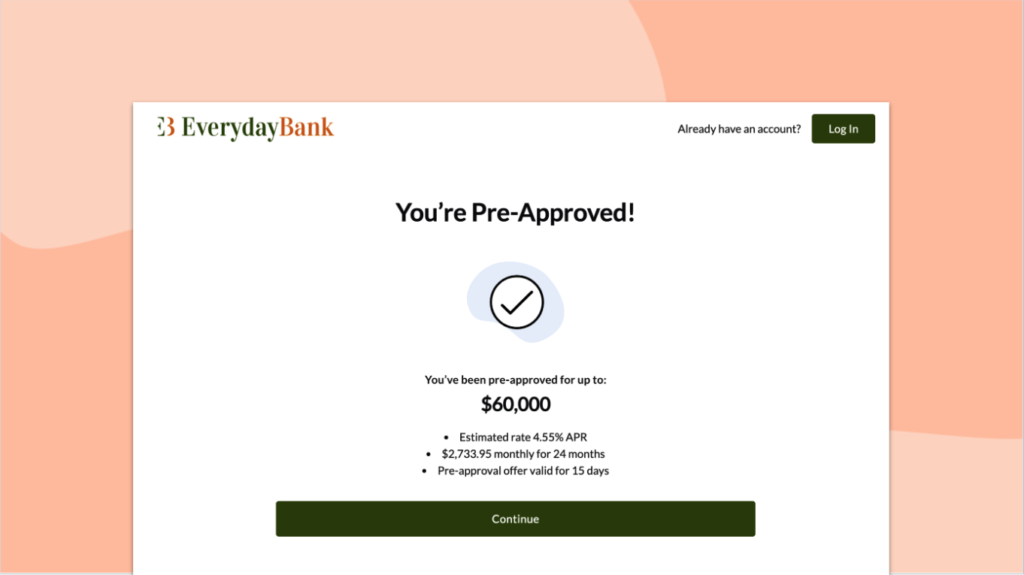
To bridge the gap, FIs have embraced a common strategy of layering a modern POS solution that enables digital applications on top of an existing LOS that handles the backend decisioning, approval process, and loan generation.
This approach can work well in a number of scenarios:
- A bank or credit union has an existing contract with an LOS provider that doesn’t expire for years, making a full LOS replacement cost-prohibitive or contractually impossible.
- There may be bandwidth limitations on internal change management and adoption and training needs that make it too cumbersome to properly upskill staff and update processes.
- An institution needs to improve the borrower experience quickly to remain competitive and can’t spare the time it takes to replace its entire system.
- There is inconsistency in user experience between deposit and loan applications that needs to be reconciled while working within existing system constraints.
When your deposit account opening experience is seamless but your loan application flow introduces friction, the disconnect may erode trust with customers and members. It can also prevent a new relationship before it starts. If a potential borrower comes to an institution looking for a loan and has a bad experience, they’re unlikely to come back for their deposit needs. For quick alignment, a POS layer can support your modernization goals without requiring a complete overhaul of your LOS.
The POS layer approach
A POS layer can deliver immediate value, but it comes with additional considerations to determine if it’s the right approach for your institution.
Clicking “submit” on an application is just the first step of the loan process. After that, there’s still communication needed for status updates, document requests, approval notifications, and closing coordination. If the underlying LOS doesn’t support modern workflows, that post-application communication stage can become limited and manual.
These manual interventions largely fall on loan officers and branch staff, creating more work and lengthening loan processes. In some cases, the LOS can push document requests to the POS interface, allowing borrowers to upload what’s needed without leaving the platform. But many don’t have that capability, meaning if a borrower uploads the wrong document or has a question, it requires the loan officer to follow up. Some POS platforms can automatically determine which documents are needed based on loan type, while others rely entirely on manual review and ad-hoc requests.
While on the surface, adopting a POS may seem like an easy win, the system’s capabilities are still determined by those of the underlying LOS. If the backend system doesn’t support automated follow-ups, real-time decisioning, and integrated document management, even the most modern front-end application can’t overcome foundational hurdles. And when there’s friction between the two systems, not only does it impact the experience, but you risk losing applicants. According to Bain & Company, digital friction causes as much as 48% of consumers to abandon the account opening process altogether.
Despite these considerations, a POS strategy can deliver immediate value for institutions that need a quick modernization boost. If you’re willing to work within the constraints of your LOS, layering on a POS can meaningfully improve the borrower experience while you continue your journey toward bigger transformation.
“While improved technologies can add value to the process,” MANTL’s Senior Product Manager Nicholas Moore points out, “it also requires taking a harder look at application questions and outdated processes to get the most out of your investments.”
The end-to-end LOS approach
An end-to-end LOS provides granular control over the entire borrower experience, from application through underwriting, closing, and funding. All these actions happen within one platform, creating continuity for both borrowers and the loan officers guiding them through the process.
While the customer and member experience is streamlined, it also means simpler workflows for staff. There’s no need to toggle between different platforms just to complete one application, minimizing the need to bridge information gaps manually. All the information they need lives together in one place.
This is particularly valuable for credit unions, where applicants often need to establish membership before they can open a loan. Without an end-to-end LOS, the loan process is stopped right before the finish line. Borrowers have to pause the loan application to complete a separate membership process, then return to the first process to finalize the loan. The process fractures at exactly the moment when it should feel seamless.
An end-to-end LOS can handle both steps in a single flow.
Embracing agility and innovation with MANTL
The financial landscape is changing rapidly and flexibility is a competitive advantage. Financial institutions shouldn’t have to choose between quick wins with a POS layer and a comprehensive solution with an end-to-end LOS. That’s why MANTL is building both as a seamless extension of its industry-leading deposit origination platform.
Since announcing its expansion into the loan market and launching its Loan Origination development partner program, MANTL has been developing flexible solutions that are built to meet banks and credit unions where they are. MANTL’s unified platform enables seamless cross-sell opportunities across deposit and loan products, improving the member and customer experience and driving institution-wide growth and efficiency gains.
Why both? Full LOS delivers the best borrower experience and operational efficiency long-term, but not every institution is ready to take that step immediately. Contracts, budgets, and change management capacity can all factor into timing.
“Rather than forcing a single path, MANTL’s approach offers flexibility. You can start where it makes sense and expand as your needs evolve.” – Nicholas Moore, Senior Product Manager, MANTL
In practice, institutions can adopt a POS layer now and transition to full LOS later, or implement a complete solution from the start. Either path works; what matters is having options that align with your current reality and your future goals simultaneously.
Regardless of which path you choose, the focus is on omnichannel consistency—the same platform powering online and in-branch experiences across deposit and loan origination. Borrowers experience continuity across every touchpoint, whether they’re starting an application on their laptop, uploading documents from their phone, or visiting a branch to finalize paperwork. Meanwhile, employees work in one system for deposits and loans, eliminating the need to toggle between platforms or learn separate workflows for different products. For credit unions, specifically, MANTL automates eligibility verification and membership creation, providing a seamless member experience. A unified platform for loans and deposits consolidates banker systems and enables institutions to have greater control over both sides of their balance sheet.
As we continue building with institutions in our partner program, our goal remains clear: deliver technology that strengthens relationships and positions financial institutions for long-term growth and innovation.
MANTL is building the future of loan origination for banks and credit unions ready for best-in-class borrower experiences.
→ Get in touch with our team to discover how our expert team can help support your lending technology transformation.